Integrity & Compliance |
 |
 |
 |
|
| |
| By
Dwight Hyland, Product Manager, Pomona Electronics (dwight.hyland@fluke.com)
And Wim Nederhoff, Fluke Industrial BV, (wim.nederhoff@fluke.com)
|
| |
| Probing For Answers
|
| |
| So,
your scope is developing intermittent problems. If you’ve
had the scope for a while, and the readings depend on how
you hold the probe, the most likely cause of the fault is
the probe itself. For example, you hold the probe just right
and the reading is perfect, but turn it too sharply, and you
lose the signal. Either way, once you see the signal change
as you change the angle of the probe, you begin to question
the accuracy of all your readings.
At this point, it is time to buy new probes. The purchase
tends to be delayed, but the quality of your scope is only
as good as the quality of the probes. The same is true if
you are looking for probes for a new scope that comes without
them. The actual probe choice will depend very strongly on
what you use them for, but users need not be locked into buying
expensive probes offered by the original oscilloscope manufacturer.
High quality probes are available from vendors like Pomona
at low cost. These can do the job equally well as the originals.
The
great number of applications in the electronics industry (along
with the great number of oscilloscope types) helps explain
the many types of probes. Companies like Pomona sell probes
that are matched to particular models, but for accurate measurements
(particularly on non-mainstream scopes), it is important to
understand a probe’s specifications. Most important
are a knowledge of input capacitance and circuit loading,
bandwidth and frequency response, and noise behavior. Finally,
when parameters other than voltages need to be measured, probes
other than voltage probes may come into play – some
examples of this are given as well. |
| |
The
ideal probe
Probes have four essential requirements. They must be easy
to connect to the circuit in front of you, must not load the
signal source, must pass on the signal accurately, and must
be immune to noise . In practice, there will always be some
loading because the oscilloscope needs to draw some sensing
current. There will always be some distortion because of stray
capacitances and inductances, and there will always be some
noise1.
These
effects can be minimized by using standard probe sets, keeping
cable lengths short, and using the correct-sized probes and
the correct adapter to the device under test.
Ideally, a probe would have infinite input resistance, zero
input capacitance, and infinite noise rejection. Compromises
among these ideal requirements and probe costs have led to
three broad probe categories: general purpose passive probes,
active probes for high-frequency measurements, and differential
probes to eliminate undesired common mode signals. These three
major categories are discussed in this article.. |
| |
| General
purpose probes
General-purpose,
passive 1:1 probes (also called x1 probes, Figure
1) were first and foremost designed to fulfill the
basic demand for an easy connection of a circuit under test
to the oscilloscope input. Initially these consisted of little
more than a shielded testlead with an ergonomically designed
circuit browser or a set of small alligator clips to make
the connection to the circuit-under-test.
Figure
1: Technical probe specifications for Pomona's
general purpose passive probes, showing the major probe parameters.

| Figure
2 |
 |
| A
complete probe set includes probe handle, insulating
adjusting tool, sprung hook, BNC adapter, 23-cm ground
lead, 25-mm ground adapter, IC tip adapter, tip cover,
rigid tip and spring-loaded tip. |
These probes (Figure 2) gives a 1:1extension
of the oscilloscope’s input channel and the voltage-under-test
is directly applied to the oscilloscope’s input. At
the probe tip of a 1:1 probe, we see the input resistance
of the connected instrument. The drawback of this type of
probe is that not only the input resistance is seen at the
probe tip, but in parallel to this we see the full cable capacitance
as well as the original input capacitance of the oscilloscope
used.
If the test frequency is increased, this results in a higher
circuit loading. In practical designs, the 1:1 probe has some
series resistance built-in in order to reduce ringing, and
this together with the circuit’s output impedance reduce
the useful bandwidth of 1:1 probes to no more than a few megahertz.
When working with a 1:1 probe, the user has to realize that
some 50 to 150 pF is loading his circuitry. Not all circuitry
will continue to function properly once this load impedance
is connected.
Reducing
circuit loading
In order to reduce the effects of circuit loading due to the
large probe tip capacitance, probes are generally built as
so-called 10:1 probes which present only about a tenth of
the probe cable capacitance at the probe tip. For that purpose,
a voltage divider is added at the probe tip. This divider
‘masks’ the cable capacitance by about the same
factor as the voltage division ratio. So a 10:1 voltage attenuation
gives almost 10 times lower probe tip capacitance, using the
same cable and oscilloscope input. This then allows for a
much wider useful bandwidth and results in much lower circuit
loading. An additional benefit is that these 10:1 probes allow
for adjustments and corrections by slightly manipulating the
exact values of the components used, resulting in a wide bandwidth
and flat frequency response.
The effect
and actual voltage division of the divider network also depend
on the input impedance of the oscilloscope the probe is connected
to. In general, oscilloscopes are built to present a 1 megohm
input resistance, and a parallel capacitance of 10 to 25 pF
is unavoidable. Probes are then designed to work with this
impedance, and provide a 10:1 attenuation ratio.
Switching
between attenuation factors
Below 1 MHz, it is the probe’s input resistance that
determines the circuit loading. Above that, the input
capacitance begins to take over. Switching between
attenuation factors also changes the input resistance and
capacitance and hence the bandwidth and associated rise time.
A 10:1 or 100:1 probe will compensate for a scope’s
input capacitance range to give a flat frequency/attenuation
ratio.
Probe
reactance affects system bandwidth
The reactance of a probe is the major contributing factor
in determining the bandwidth (maximum –3dB
frequency) of the scope/probe system. The bandwidth is then
defined as the highest frequency that can be displayed with
an amplitude that is no more than 3 dB lower than the actual
signal amplitude is. Verification is done by comparing high
frequency response to low frequency response.
Scope
manufacturers indicate the 'useful system) bandwidth'. This
is the bandwidth of the oscilloscope that the probe can be
used with without reducing the overall system bandwidth. A
scope probe that is offered for use with a 100 MHz scope should
again result in a system bandwidth of 100 MHz. Seldom do you
find the probe only bandwidth, as there is hardly a way to
determine it and no way to benefit from it. Probes should
match or exceed the scope's bandwidth - if a probe would have
a probe-only bandwidth of say a 100 MHz and would be used
on a 100 MHz scope, the amplitude on screen will be 3 dB down
at the rated frequency. And this 3 dB equals an amplitude
reduction (error) of about 30%! If this sounds like a large
error to you, remember that most scopes have a DC
accuracy of 2 to 3%, sometimes more. At frequencies beyond
a few kilohertz, the effects of frequency-roll off start coming
into play, and at the specified bandwidth the amplitude response
is down by 3 dB. At even one quarter of the bandwidth this
can easily lead to amplitude errors like 10%.
Measuring
risetimes
The bandwidth has a corresponding pulse risetime (the time
to respond to an instantaneous pulse). When the user wants
to measure a signal’s risetime he needs to use an oscilloscope
plus probe combination that has a bandwidth sufficiently wide
to cope with the highest frequency components contained in
the signal. Hence, the risetime of scope plus probe needs
to be significantly shorter than that of the signal under
study. If not, the scope plus probe will dominate the measurement,
and not the signal under study. The rise time of scope plus
probes should be less than a quarter of that of the signal
waveform for the resulting risetime on the scope screen to
be within about 3%.
Input
capacitance is more important than resistance in pulse risetime
measurements, while the resistance is more important in pulse
amplitude measurements. As a general rule of thumb, pick a
probe with the highest overall input impedance (highest input
resistance and lowest input capacitance) for the lowest circuit
loading effect. Since fast risetime is closely related to
high bandwidth, pick a probe with the lowest capacitance for
best results. If multiple testpoints are available that carry
the same signal, choose the point that has the lowest circuit
impedance, because there the signal will least be affected
by the probe being connected. Pomona probes are designed to
give a full, accurate voltage read-out throughout the entire
rated probe bandwidth. These probes include such important
features as low input capacitance and high bandwidth to meet
the high-performance demands of today’s oscilloscopes.
Each scope
has its own input resistance and input capacitance, and careful
probe design is needed to avoid influencing a scope’s
response. Cable lengths should be kept short to prevent capacitive
loading.
Reading
voltages with attenuating probes
Apart from the low complexity of the 1:1 probe, another advantage
is that the measured voltage seen on the oscilloscope is in
fact the actual voltage at the probe tip. This is not the
case with 10:1 and 100:1 probes, and in order to read the
actual voltage at the probe tip from the measurement on the
oscilloscope screen, the user has to take the probe’s
attenuation into account, so multiply any amplitude measurement
result with 10 or 100. Some scopes can sense the probe attenuation
factor and account for this to show the correct vertical (V/div)
sensitivity settings on screen. Some others have a possibility
to manually set this probe type and have the oscilloscope
adopt its reading and/or measurement results.
Thanks
to the probe recognition system the oscilloscope can work
with an attenuator setting of say 10 mV/div, and indicate
the overall vertical sensitivity as 100 mV/div thereby taking
into account the effect of the 10:1 probe. The result is that
the amplitude measurements are correct and do reflect the
actual voltage at the probe tip. This also requires a readout
actuator on the probe to communicate the probe attenuation
factor to the scope. Probes with readout actuators are available
from vendors like Pomona.
Multi-channel
measurements
In many cases an oscilloscope is used to make signal comparisons,
e.g. input signal versus output signal of an amplifier system,
logic system, etc. Some applications require the analysis
of even more signals, hence four channel oscilloscopes are
wide spread. For such multiple-channel measurements in particular,
it is important to make sure that both (or all) probes have
the same characteristics: the same bandwidth and risetime,
the same frequency characteristics. When timing measurements
are made in the nanoseconds range, it is also important to
ensure that all probes have the same physical cable length.
As a signal travels through a coaxial cable at a speed of
5 ns per meter or slower, a difference in cable length may
easily result in timing errors in the nanoseconds range. For
this reason it is best to replace a defective probe by another
one of the same type, or alternatively to replace multiple
probes at the same time. |
| |
| Active
probes for high-frequency measurements
Attenuating resistors in the passive probe increase the input
impedance, but at the expense of signal strength. Active probes
use devices like FETs (field effect transistors) to increase
the input impedance and reduce input capacitance below 1 pF
without losing signal strength. Active probes are therefore
needed for very high-impedance circuits to avoid overloading
them, and for extremely high frequency measurements into the
GHz range.
At frequencies
like hundreds of megahertz, the bandwidth limitations of passive
probes form a practical limitation, because the probe tip
capacitance forms too low an impedance and truly disrupts
the proper functioning of the circuitry under test. As circuitry
running at these frequencies is usually laid out using transmission-line
interconnections (e.g. 50 or 75 ohms coaxial lines), probes
with 500 ohms resistive impedance are used here, that are
connected to 50 ohms cables and 50 ohms coaxial oscilloscope
inputs, thereby giving a 10:1 voltage division. Such probes
are generally referred to as ’50 ohm probes’.
Other resistance values are used as well, giving 20:1 or even
50:1 voltage division ratios. |
| |
| Ground
connections
Essentially, any voltage probe measures the voltage between
the probe’s center tip and the ground contact. Too long
a ground lead will add inductance to this signal path, which
may cause ringing on the waveforms measured. Some users rely
on the safety ground for the probe to find its reference potential.
By doing so, large measurement errors are easily created,
especially in the medium and higher frequencies. Additional
ringing may result from the long wiring, and stray voltages
may influence the measurement due to other currents flowing
through the overall wiring.
Always
use a ground- or reference contact on each individual probe
and make sure this is as short as possible. Don’t extend
the ground leads supplied with the probes in any way.Most
probe manufacturers deliver a dedicated spring-loaded ground
contact with high frequency probes, that is no longer than
½ inch and that is meant for critical measurements
in the higher frequency ranges.
At high
frequencies, a lead's distributed inductance and capacitance
may also need to be considered. Ground paths particularly
should be short to minimize the series inductance which, with
the probe capacitance, causes ringing at specific frequencies.
Probe manufacturers reduce these effects by selecting the
inductance to raise the ringing frequency above the scope/probe
bandwidth. Leads should hence be extended only carefully.
Although it is convenient to extend probe leads when checking
large boards, this can cause ringing on step changes in input.
Probes
should be shielded to make them (relatively) immune to noise
sources. FET probes generally have a 50 ohms output impedance
for driving 50 ohms cables, which increases the permissible
length of coax cable. Their low maximum input voltage of usually
only a few volts limits the application of active probes to
measurements on fast semiconductor circuits. |
| |
| Differential
probes for low noise applications
| Figure
3 |
 |
The
signals measured by differential probes are subtracted
by a differential ampllifier, improving sensitivity
to small signal differences. |
Differential
signals, also identified as ‘symmetrical signals’
(in phone, power and disk read circuits, for example) need
differential probes. Although all measurements are differential
in the sense that they measure the voltage difference between
two points, a differential probe (Figure 3)
measures two signals that may both be above ground. The signals
are subtracted by a differential amplifier, which helps improve
sensitivity for low amplitude signals (which particularly
can be plagued by noise and lack of sensitivity). The differential
amplifier is greatly insensitive to common mode signals, that
is signals that have the same amplitude and phase and that
are applied to both inputs, such as those resulting from crosstalk
and noise from adjacent circuitry.
Single-ended
measurements (i.e. measurements referenced to ground or to
a common), can cause amplitude and timing errors in high-speed
signals. Differential probes like the Pomona differential
probe are matched, to avoid delay differences between signal
paths from skewing the signals. Here particularly, the two
leads should be identical. Ground loops must also be minimized,
and kept short. A simple way of reducing distortion from noise
and line-frequency is to twist the two probe cables together.
Differential
probes also give a high common-mode noise rejection and may
be needed in noisy environments. Floating measurements (the
term for differential measurements in power systems, because
there the isolation from the lethal power voltages is a critical
parameter) also often require high common mode rejection to
detect the smaller voltage signals of interest. Floating measurements
taken in the field should have full insulation for extra safety,
and can therefore best be carried out using safety-designed
portable scopes.
Probes
should be designed to standards like IEC1010-2-031, with insulation
for the entire probe including the BNC connector. For Pomona
probes, a spring-loaded sheath covers the tip ground point,
and there is a compensation point in the BNC end.
Measurements
on power systems call for special precautions as the general
oscilloscope is itself ground referenced, and has this power
ground reference contact directly connected to the signal
common or signal reference – namely the shielding of
the probes and the ground contact near the probe tip. Without
dedicated precautions, measurements directly on the mains
power (and on any circuitry connected to it) may lead to short
circuiting the mains power system to ground.
Some people
try to avoid this by interrupting the ground wire in the scope’s
power cord, thereby imposing the risk of death or injury due
to lethal voltages being present on the oscilloscope’s
common reference and front panel! The proper way to make such
mains power-related measurements, is to use a safety designed
scope without any common ground contacts, such as Fluke’s
ScopeMeter 190 Series. If no such instrument is available,
a differential probe with insulation may be used to keep the
lethal mains voltages away from the scope input and from the
ground contact, still providing the necessary measurement
capability. |
| |
Adapting
to fine-pitch ICs and surface mount devices
It should be easy to connect the probe to a test point, since
probing a difficult connection can give inaccurate readings.
Needle type probe tips are fine when the probe just needs
to be touched to the test point to make a connection. Retractable
hook tips are easier for leaving the probe attached and making
adjustments. Manufacturers like Pomona provide probes with
special tips for fine-pitch ICs and other test points that
are hard to reach. Many Pomona scope probes also offer a spring-loaded
pogo pin as the main contact pin. This offers advantages to
the end user like a steadier contact to the test point, replaceability
of the probe tip, and choice of pin tips.
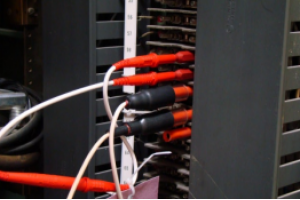
Surface
mounting circuits also need specialized connectors. The Pomona
Micro SMD Grabber test clips shown in Figure 4,
for example, clip to the tip of the oscilloscope probe (Figure
5). Ground and tip leads are short for minimum noise
(Figure 6), and the clips can be used with
PQFP packages with 0.3 to 0.5 mm lead pitches. A thin body
design allows an unlimited number of clips to be stacked side
by side. Corresponding long-tipped probes work with 0.5 mm
lead pitches or greater, also maintaining 100 MHz maximum
frequencies.
For
the miniaturized contacts of surface mount components, the
first of a probes’ four basic requirements (easy connection
to the circuit in front of you) is particularly clear. Meeting
the other three requirements (input impedance high enough
to avoid loading, accurate signal relay, and noise immunity)
can involve
complicated calculations. High-quality and experienced probe
suppliers like Pomona (which has been building electronic
probes and connectors for 50 years) make the work much, much
easier.
| Figure
4 |
Figure
5 |
|
|
| Micro
SMD Grabber test clips have a very thin body, and stack
side by side for PQFP, SOIC, TSOP and SSOP packages. |
Probe
tip adapters connect Micro SMD Grabber test clips to
the oscilloscope. |
| Figure
6 |
 |
| Micro
SMD Grabber test clips have short ground, and tip leads
are short for minimum noise. |
|
| |
| Other
probe types
While standard oscilloscope probes measure only voltage, current
probes measure current, usually by means of a current transformer.
Conventional AC-only current probes use a transformer to convert
current flux into a voltage to be presented to the oscilloscope
input. Frequency responses are from a few hertz up to some
gigahertz. Adding a Hall-effect device reduces the frequency
response down to DC, but also limits the maximum frequency
to around 50 MHz.
Current
probes can be used next to voltage probes to read both voltage
and current at the same time and measure both parameters as
a function of time simultaneously. From this, the most advanced
oscilloscopes can calculate power waveforms, representing
power as a function of time, so as to determine the instantaneous
power handled by, for instance, power FETs or linear amplifier
stages. As with voltage probes, current probes must not overload
the circuit, and must have an appropriate bandwidth and rise
time.
High-voltage
probes use higher attenuations (x100 and higher), and have
lower input capacitance (about 3 pF typically). Here and elsewhere,
high-voltage safety limits for probes should never be exceeded,
this is particularly true of the maximum input voltage,
which will usually be derated with frequency. Make sure you
are aware of how maximum allowed voltages diminish with frequency
for the particular probe you’re using. Furthermore,
safety measures need to be kept in mind even more strictly
when working with high voltages than in low voltage application,
as mistakes may have permanent consequences to the probe user….
The international standard EN61010-2-031was written specifically
to provide probe manufacturers with design rules that ensure
safety of the probe construction, and thus assure the safety
of the technician applying these probes. When selecting a
probe, make sure that it is specified according this standard
and use it according the instructions provided by the probe
manufacturer, so as to secure your own personal safety!
|
| |
| Conclusion
In essence, when looking for replacement general-purpose scope
probes, look for accuracy, versatility, and value. Make sure
that the probe you’re considering meets the safety requirement
for the application you have in mind, and don’t use
the probes beyond the specified voltages. Fine tip probes
are needed to explore high-density chip leads with less than
0.060-inch (1.5 mm) spacing. Modular probe handles are useful
to receive a variety of spring loaded and fixed tips, for
greater testing versatility. |
| |
About
the author:
Dwight Hyland is Product Manager for Pomona Electronics. During
his twenty years in the electronics industry, Hyland has served
in a number of capacities including product specialist, product
planning, and product development management until assuming
product management responsibilities for the electronic product
line. |
|
|
|
|